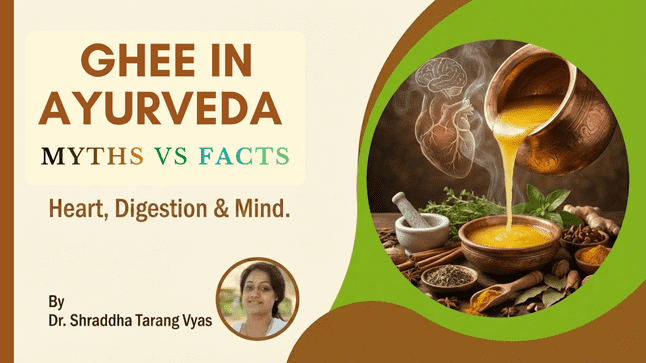
Few foods have experienced as much confusion as ghee. Once celebrated as the golden nectar of Ayurveda, ghee later became a victim of modern fat-phobia, often labeled as unhealthy due to its saturated fat content.
Patients frequently ask us:
“Doctor, is ghee bad for cholesterol?” “Can ghee cause heart disease?”
Ayurveda and modern science give a very different answer than popular myths.
The truth lies in understanding how ghee works inside the body, not just counting fat percentages. Interestingly, modern research is now slowly aligning with Ayurvedic wisdom.
What Is Ghee? Ayurvedic Explanation
Ghee (Ghrita) is clarified butter prepared by gently heating butter to remove:
✓Water
✓Milk solids (lactose & casein)
What remains is pure, stable fat with powerful therapeutic properties.
Traditional Ayurvedic Method
In Ayurveda, ghee is made by:
✓Culturing cow’s milk into curd
✓Churning curd into butter
✓Slowly clarifying butter into ghee
This process enhances Agni (digestive fire) and makes ghee Sattvic in nature.
✓Safe for many lactose-intolerant individuals
✓Long shelf life
✓High smoke point
Ghee Myths vs Facts (Ayurveda & Science)
Myth 1: Ghee Causes Heart Disease
Fact: Ghee supports heart health when used correctly.
Ghee contains:
–Saturated fats (natural, non-toxic)
–Monounsaturated fats
–Short & medium-chain fatty acids
Unlike trans fats, ghee:
–Reduces inflammation
–Supports healthy lipid metabolism
–Is non-atherogenic (does not clog arteries)
Studies from Rajasthan showed lower heart disease prevalence among habitual ghee consumers.
Myth 2: Ghee Increases Bad Cholesterol (LDL)
Fact: Moderate ghee improves lipid profile.
Research shows:
Ghee contains:
–Ghee increases HDL (good cholesterol)
–Does not significantly raise LDL
–Contains CLA (Conjugated Linoleic Acid)
HDL removes excess cholesterol from blood vessels, protecting the heart.
Myth 3: Ghee Is Heavy and Causes Weight Gain
Fact: Ghee improves digestion and metabolism.
In Ayurveda:
–Ghee kindles Agni
–Nourishes intestines
–Prevents bloating and dryness
Scientifically :
–Rich in Butyric Acid
–Feeds gut bacteria
–Reduces intestinal inflammation
MCTs in ghee are burned as energy, not stored as fat.
Recommended dose: 1–2 teaspoons per day
Myth 4: Ghee Is Only for Cooking
Fact: Ghee is medicine for the mind and skin.
Brain Health:
Ayurvedic texts state ghee enhances:
–Dhi (intelligence)
–Smriti (memory)
–Buddhi (intellect)
Skin Healing:
Used in:
–Shatadhauta Ghrita
–Burns, wounds, eczema
–Anti-aging therapies
Ayurvedic View on Ghee (Tridosha & Sattva)
1. Tridosha Balance
–Lubricates & grounds
–Cools inflammation
–Builds Ojas when used moderately
2. Yogavahi (Carrier of Medicine)
–Ghee carries herbal properties deep into tissues (Dhatus).
3. Sattvic Nature
Promotes:
–Calm mind
–Mental clarity
–Emotional balance
Nutritional Value of Ghee
Ghee is rich in:
–Vitamin A – vision & skin
–Vitamin E – antioxidant
–Vitamin D & K – bone health
–CLA – anti-inflammatory
–Omega-3s (grass-fed ghee)
Types of Ghee in Ayurveda
Cow Ghee (Best)
–Cooling
–Enhances memory
–Ideal for daily use
Buffalo Ghee
–Heavy
–Induces sleep
–Increases Kapha
Goat Ghee
–Light
–Useful in respiratory issues
Purana Ghrita (Aged Ghee)
–Medicinal use
–Neurological & psychological disorders
How to Use Ghee Correctly
✓Add to warm rice or dal
✓Use for high-heat cooking
✓Nasya (under guidance)
✓Abhyanga (massage)
Final Verdict: Is Ghee Healthy or Harmful?
When used according to Ayurveda, ghee:
✓Supports heart health
✓Heals the gut
✓Improves brain function
✓Nourishes skin
✓Builds Ojas
The problem is misuse, not ghee itself.
Ayurveda teaches balance, not elimination.
Medical Disclaimer
Consume ghee in moderation. Individuals with medical conditions should consult a qualified Ayurvedic physician.
FAQ
Yes. Ayurveda considers ghee (Ghrita) a rejuvenating and Sattvic food that balances Vata and Pitta, supports digestion, improves memory, and nourishes body tissues when consumed in moderation.
No. According to Ayurveda and emerging scientific studies, moderate consumption of ghee does not increase heart disease risk and may improve good cholesterol (HDL) while reducing inflammation.
Moderate intake of ghee may increase HDL (good cholesterol) without significantly raising LDL (bad cholesterol). Excess consumption, however, may affect lipid levels in some individuals.
Ayurveda generally recommends 1–2 teaspoons of ghee per day, depending on digestion (Agni), body constitution (Prakriti), and season.
Yes. Cow ghee (Gau Ghrita) is considered superior in Ayurveda due to its cooling, nourishing, and intellect-enhancing properties compared to buffalo or goat ghee.
Yes. Ghee strengthens digestive fire (Agni), heals the gut lining, reduces acidity, and supports healthy intestinal bacteria due to its butyric acid content.
When used in moderation, ghee can support metabolism and satiety. The medium-chain fatty acids in ghee are used as energy rather than stored as fat.
Most lactose-intolerant individuals can tolerate ghee because it contains negligible lactose and casein. However, individual tolerance may vary.
Yes. Ghee has a high smoke point (around 250°C), making it one of the safest fats for Indian cooking and frying.
Purana Ghrita is aged ghee stored for several years and used therapeutically in Ayurveda for neurological, mental, and chronic disorders under medical supervision.
Conclusion: The Ayurvedic Truth About Ghee
Ghee is not an enemy of health; misunderstanding is. Ayurveda teaches us that any food—when consumed without knowing one’s digestion, body type, and lifestyle—can become harmful. When used consciously, ghee supports digestion, nourishes the gut, protects the heart, and enhances mental clarity. At Dr Shraddha Ayurveda , we often guide patients through personalized dietary corrections where ghee plays a therapeutic role alongside Ayurvedic diet planning and Panchkarma therapies. True wellness is not about avoiding traditional foods, but about understanding how, when, and how much your body truly needs.