What Is Prakriti in Ayurveda? Discover Your Unique Mind-Body Constitution
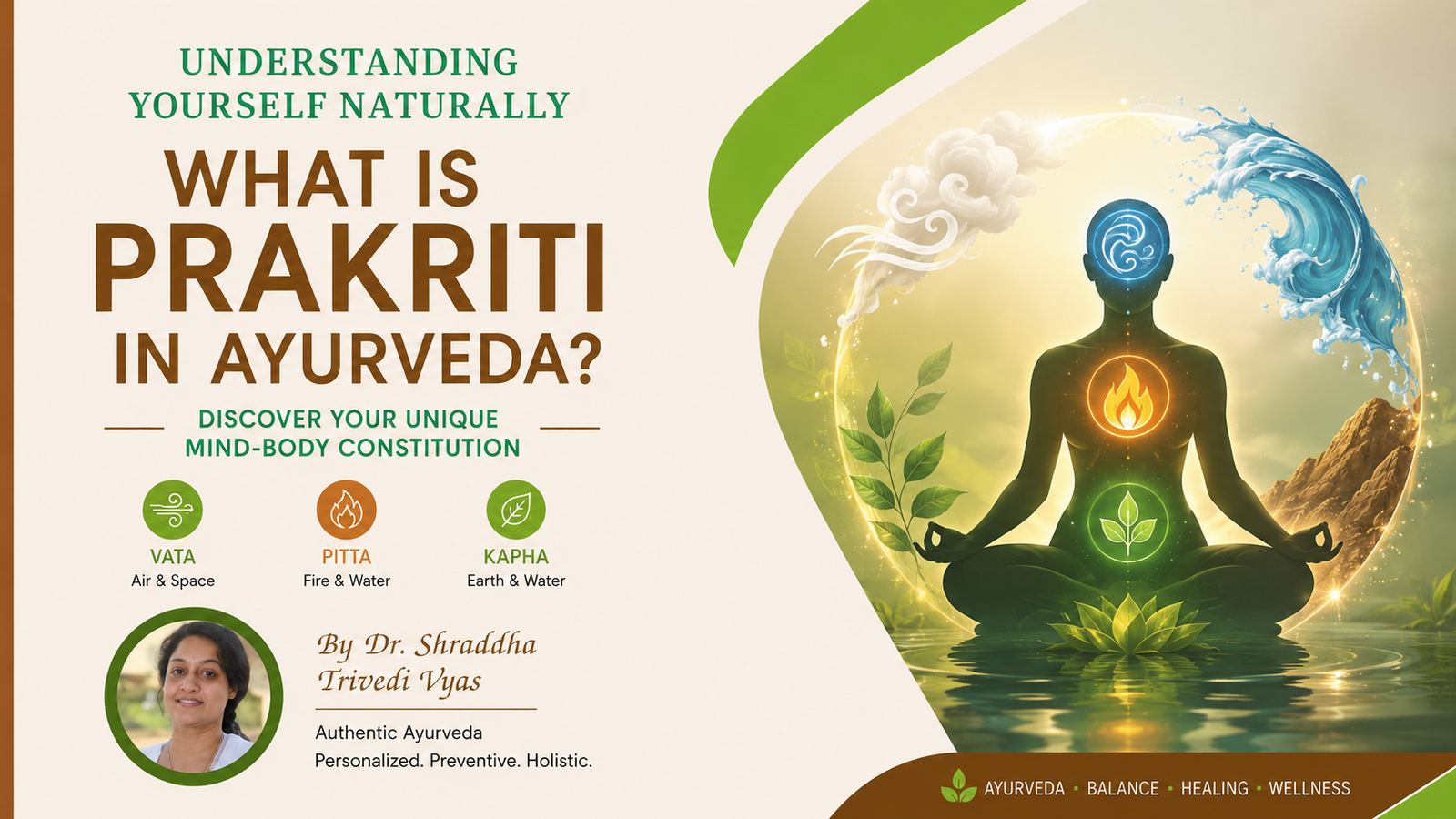
What Is Prakriti in Ayurveda? Discover Your Unique Mind-Body Constitution
Have you ever wondered why two people eating the same food, following the same routine, and living in the same environment experience completely different health outcomes?
One person remains energetic and healthy, while another struggles with digestion, weight gain, stress, skin issues, or chronic diseases.
According to Ayurveda, the answer lies in your Prakriti — your unique mind-body constitution.
Ayurveda teaches that every individual is born with a distinct constitutional blueprint that influences physical appearance, digestion, metabolism, emotional tendencies, disease susceptibility, and overall health throughout life. Understanding your Prakriti is the first step toward truly personalized healthcare.
What Does Prakriti Mean?
The Sanskrit word “Prakriti” is derived from:
Thus, Prakriti means “Original Nature” or “Natural Constitution.”
Prakriti is established at the time of conception and is influenced by the predominance of Doshas, parental constitution, maternal health, diet, season, and various environmental factors. Once formed, it remains relatively constant throughout life.
Classical Ayurvedic Reference
“विकारो धातुवैषम्यं साम्यं प्रकृतिरुच्यते”
Meaning: Balance is the natural state (Prakriti), while imbalance gives rise to disease.
This fundamental Ayurvedic principle explains why maintaining harmony with one’s constitution is essential for long-term health.
The Foundation of Prakriti: Tridosha
Ayurveda describes three governing biological energies known as Doshas:
Vata Dosha (Air + Space)
Vata governs movement, communication, circulation, breathing, and nervous system functions.
People with dominant Vata characteristics often have:
Unlike trans fats, ghee:
Pitta Dosha (Fire + Water)
Pitta governs digestion, metabolism, intelligence, and transformation.
Typical Pitta traits include:
When aggravated, Pitta may lead to:
Kapha Dosha (Earth + Water)
Kapha provides stability, strength, immunity, and structure.
Common Kapha characteristics:
When Kapha becomes excessive, individuals may develop:
The Seven Types of Prakriti
Ayurveda broadly classifies constitutions into seven categories:
Single Dosha Types
Dual Dosha Types
Tridoshic Type
Most individuals possess a dual-dosha constitution, while perfectly balanced Tridoshic constitutions are comparatively uncommon.
Why Is Knowing Your Prakriti Important?
Ayurveda does not believe in a “one-size-fits-all” approach.
The same food, exercise routine, medicine, or detox plan may benefit one person while harming another.
Understanding your Prakriti helps determine:
Suitable Diet
Which foods nourish your body and which create imbalance.
Ideal Lifestyle
The daily routine that supports your energy and well-being.
Exercise Recommendations
The type and intensity of exercise suitable for your constitution.
Disease Predisposition
Health conditions you may be naturally prone to develop.
Personalized Ayurvedic Treatment
Selection of herbs, therapies, Panchakarma procedures, and lifestyle modifications based on your constitution.
Prakriti and Disease Prevention
Ayurveda emphasizes prevention over cure.
When individuals understand their constitution, they can identify early signs of imbalance before disease manifests.
For example:
By aligning diet and lifestyle with Prakriti, many chronic health concerns can be prevented before they become severe.
How Is Prakriti Determined?
While online questionnaires provide a useful starting point, classical Ayurveda recommends a detailed assessment by an experienced Ayurvedic physician.
Traditional evaluation includes:
A trained Ayurvedic physician can distinguish between:
Prakriti
Your natural constitution.
Vikriti
Your current state of imbalance.
This distinction is crucial because many people mistake their present symptoms for their true constitution.
Prakriti and Nadi Parikshan
In traditional Ayurveda, Nadi Parikshan is considered one of the most effective methods for understanding an individual’s constitutional makeup.
Through pulse examination, an experienced Vaidya can assess:
This enables highly personalized recommendations rather than generalized treatments.
A Timeless Ayurvedic Wisdom
Sanskrit Verse
“समदोषः समाग्निश्च समधातु मलक्रियः ।
प्रसन्नात्मेन्द्रियमनाः स्वस्थ इत्यभिधीयते ॥”
— Sushruta Samhita
Meaning
A truly healthy person is one whose Doshas, Agni (digestive fire), tissues, and elimination processes are balanced, and whose mind, senses, and soul remain peaceful.
This verse beautifully captures the ultimate goal of Ayurveda: maintaining harmony according to one’s natural constitution.
Discover Your Prakriti
Understanding your Prakriti is one of the most powerful steps toward personalized health and wellness.
Whether you are struggling with digestive issues, thyroid disorders, diabetes, migraines, skin problems, PCOS, obesity, joint pain, or simply seeking preventive healthcare, knowing your Ayurvedic constitution can help guide more effective lifestyle and treatment decisions.
Click here and take the Prakriti Assessment and begin your journey toward better health through the timeless wisdom of Ayurveda.
For a detailed constitutional assessment, Nadi Parikshan and personalized Ayurvedic guidance from an experienced Ayurvedic physician are recommended.