Shirodhara Benefits for Brain Health: Ancient Ayurvedic Wisdom Meets Modern Science
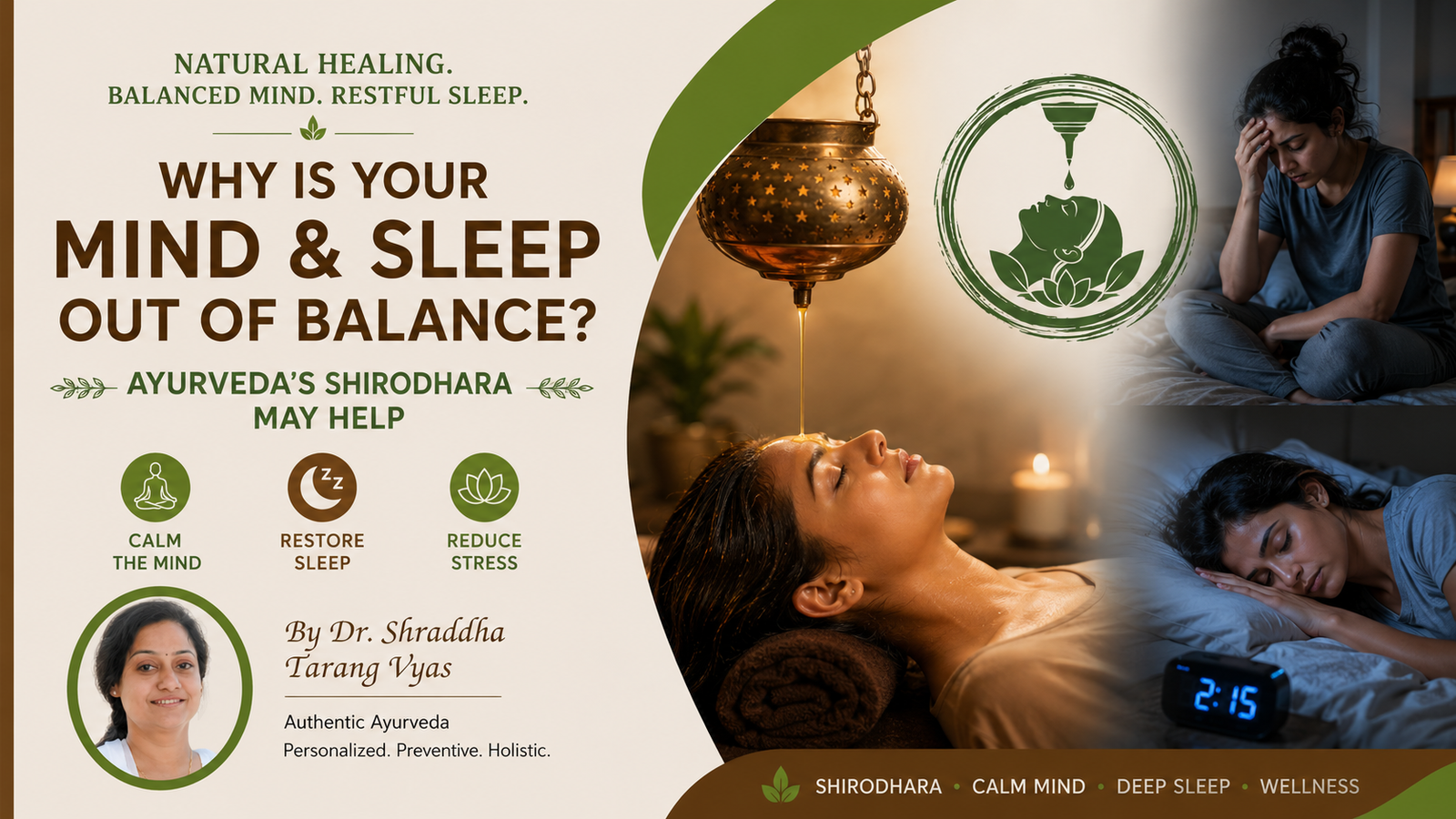
If you’ve ever felt so mentally exhausted that even sleep doesn’t feel restful, you’re not alone. In today’s always-on world, stress, insomnia and anxiety have quietly become the most common reasons patients walk into an Ayurvedic clinic. And time and again, one therapy keeps coming up as a genuine game-changer — Shirodhara.
If you’ve heard the word but aren’t quite sure what it involves or why Ayurveda considers it one of the most powerful therapies for the mind, this blog breaks it down — from its classical roots in the Charaka and Sushruta traditions to what modern research, including EEG studies, is now confirming.
What Is Shirodhara?
The word comes from two Sanskrit roots — shira (head) and dhara (a continuous stream). True to its name, Shirodhara involves a slow, steady, uninterrupted stream of warm medicated liquid poured gently over the forehead, usually focused on the space between the eyebrows — a region Ayurveda considers deeply connected to the mind and senses.
Depending on the person’s constitution and the condition being treated, the liquid used can be medicated oil, ghee, milk, buttermilk, an herbal decoction, or even coconut water. Classical texts also refer to related procedures such as shiraseka, shiraparisheka, murdhaseka, and anusechana — showing that head-pouring therapies have long held a special place in Ayurvedic practice, not as a modern spa invention, but as a well-established clinical procedure.
The Classical Ayurvedic Perspective
Ayurveda explains the effect of Shirodhara primarily through its impact on Vata and Pitta dosha, particularly when these are disturbed in the head and nervous system. When Vata is aggravated, we experience restlessness, racing thoughts, and disturbed sleep. When Pitta is out of balance, irritability, heat, and overactive thinking take over. Shirodhara acts as a calming counterbalance to both.
Classical Ayurvedic literature associates Shirodhara with relief from headache, insomnia, anxiety, psychosomatic complaints, generalized stress, hypertension, exhaustion, and even certain neurological imbalances. It’s also credited with supporting steadiness of mind and speech, sharper memory retention, sound sleep, softer skin, and clearer vision — a fairly comprehensive list for a therapy that, on the surface, looks as simple as warm oil flowing over the forehead.
Charaka himself placed enormous importance on sleep as a pillar of health, noting that a person’s happiness, strength, knowledge, and even lifespan are deeply tied to the quality of their nidra (sleep). Shirodhara, by calming the manas (mind) and pacifying disturbed doshas, becomes a natural bridge back to restorative sleep.
How Shirodhara Supports Brain and Mental Health
When Ayurvedic practitioners talk about the “brain benefits” of Shirodhara, it isn’t a claim about curing structural brain disease — it’s about restoring balance to the nervous system and mental function. In classical terms, this works through:
In other words, Shirodhara doesn’t force the brain into a different state — it gently guides an overworked nervous system back to equilibrium.
What Modern Research Is Discovering
While Ayurveda has relied on this therapy for centuries, modern science is beginning to validate what practitioners have long observed clinically.
A pilot study on healthy volunteers found that a single session of Shirodhara improved mood and lowered self-reported stress scores. Physiologically, participants showed a reduced breathing rate, lower diastolic blood pressure, and slower heart rate — all signs of the body shifting out of a stressed, sympathetic state. Interestingly, EEG recordings showed increased alpha rhythm activity, a pattern typically associated with a relaxed-yet-alert mental state, similar to what’s observed during meditation.
In a separate clinical study involving insomnia patients, Shirodhara significantly improved sleep-related symptoms with no adverse effects reported. Notably, combining Shirodhara with an internal herbal formulation produced even stronger results than either therapy alone — reinforcing Ayurveda’s core principle of tailored, combination-based treatment.
More recent EEG-based research examined Shirodhara performed with Ksheerabala oil and found measurable relaxation-related changes in the frontal region of the brain, specifically in alpha/beta and theta/beta ratios. This matters because it moves the conversation beyond “patients feel relaxed” toward objective, measurable neurophysiological change.
There’s also encouraging early evidence that adding Shirodhara to yoga therapy in adults with anxiety disorders may improve executive memory and sleep quality — suggesting its benefits may extend into cognitive function, not just symptom relief.
Why Shirodhara Feels So Deeply Calming: The Possible Mechanism
Both classical Ayurveda and modern physiology offer complementary explanations for why this therapy feels so uniquely soothing.
In Ayurvedic terms, the steady, rhythmic stream of warm liquid over the forehead pacifies aggravated Vata, increases grounding Tamoguna in the head region, and gently guides the mind toward stillness and sleep.
From a physiological lens, the continuous sensory stimulation on the forehead may alter autonomic nervous system activity, redirect attention inward, and reduce sympathetic (fight-or-flight) arousal — much like the changes observed during meditation or yoga nidra. Many practitioners describe Shirodhara as inducing a natural “relaxation response,” without relying on any sedative medication.
Who Can Benefit From Shirodhara?
Traditionally and in contemporary clinical practice, Shirodhara is most commonly recommended for:
It’s important to understand Shirodhara as a supportive, adjunctive therapy — a powerful tool within a broader Ayurvedic treatment plan, rather than a standalone cure for every condition.
Choosing the Right Liquid Matters
Not all Shirodhara is the same, and this is where an experienced Ayurvedic physician makes a real difference. The liquid used is chosen based on your unique constitution (Prakriti) and the imbalance being treated:
This personalisation is exactly why generic, one-size-fits-all Shirodhara sessions (common in unsupervised spa settings) rarely deliver the same results as a therapy prescribed by a qualified Ayurvedic doctor.
A Word on Safety
Shirodhara is generally a gentle, low-risk therapy, but technique matters. Poorly regulated temperature, stream height, duration, or an inappropriate choice of liquid can cause headache, burning sensation, faintness, or nausea instead of relaxation. It should always be performed by a trained practitioner who assesses your dosha and health history first.
It’s also worth being honest about the evidence: most current studies are small and short-term. The results are genuinely promising, but Shirodhara should be positioned as a well-supported complementary therapy — not an overnight miracle cure.
The Takeaway
Shirodhara sits at a rare intersection of classical wisdom and modern curiosity. Ayurveda explains its benefits through the pacification of Vata and Pitta and the stabilisation of the mind; modern science is now backing this up with measurable changes in mood, sleep architecture, autonomic balance, and EEG alpha activity.
If stress, restless sleep, anxiety, or mental fatigue have become your new normal, Shirodhara offers a time-tested, non-invasive way to help your nervous system remember what calm actually feels like.
FAQs
Ready to Experience Shirodhara for Yourself?
If you’re struggling with sleepless nights, constant stress, or a mind that never seems to switch off, don’t wait for it to become a bigger problem. At Dr. Shraddha’s Ayurvedic Clinic , every Shirodhara session is personalised to your unique Prakriti and health condition — because generic treatment rarely gives lasting results.
Book a consultation with Dr. Shraddha today and discover an authentic, classically-rooted Shirodhara experience designed to calm your mind, restore your sleep, and bring genuine balance back into your life.
Book Your Shirodhara Consultation Now | Visit www.drshraddha.in